
The hidden cost of outsourced bottles
Pre-formed PET bottles take up significant warehouse space. You pay not just for the plastic but for the air inside each bottle — because they are delivered fully formed. Transport costs are high per unit because you are essentially shipping a lot of empty space. Minimum order quantities from bottle suppliers may also force you to hold large inventory to get competitive pricing.
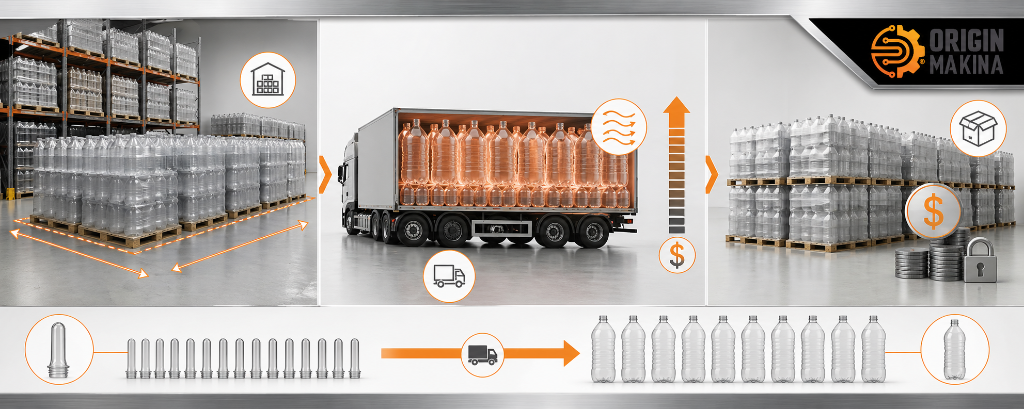
Pre-formed bottles occupy 20–30x more warehouse space than equivalent PET preforms — a massive hidden logistics cost.
What a blowing machine changes
A PET bottle blowing machine uses PET preforms — small test-tube shaped plastic pieces — and blows them into full bottles using heat and air pressure. Preforms are compact, stack efficiently, and are dramatically cheaper to transport and store. You produce bottles on demand, at the rate your filling line requires, eliminating the lead time from a bottle supplier.
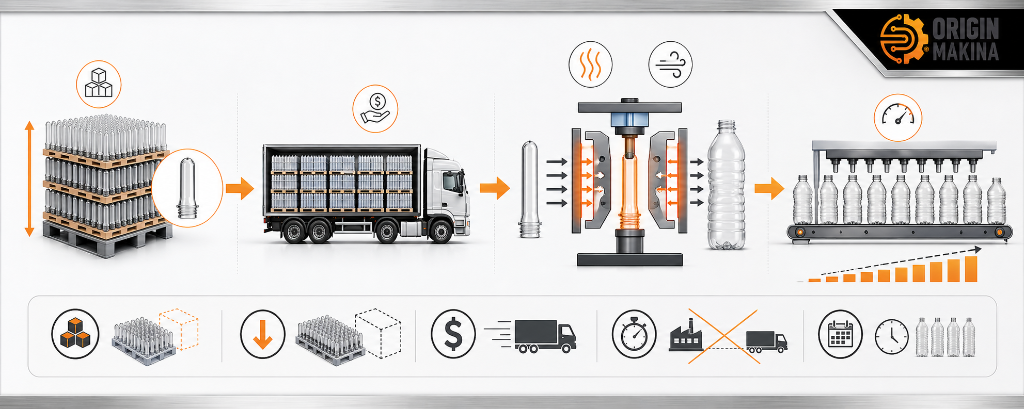
PET preforms are compact and cheap to ship — a blowing machine converts them to finished bottles on demand at your line.
The economic threshold
In-house bottle blowing becomes economically attractive at higher production volumes where the capital cost of the blowing machine is offset by the savings on bottle procurement and storage. The calculation is specific to each operation — bottle size, volume, local supplier pricing, and storage cost all factor in. Origin Makina can help you model this calculation for your specific situation.
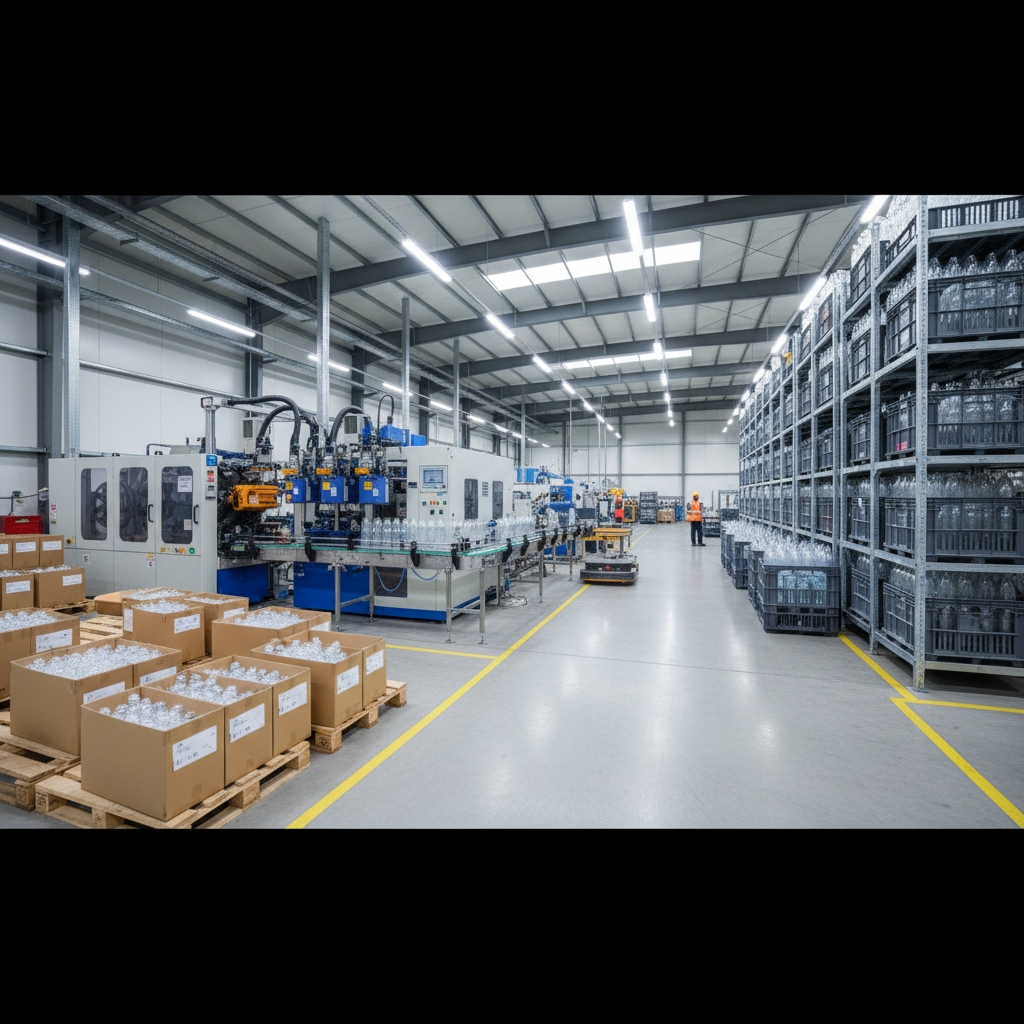
At the right production volume, blowing machine capex is quickly offset by savings on bottle procurement and storage costs.
Integration with the filling line
The key engineering challenge is matching the blowing machine output speed to the filling line input speed. Origin Makina designs the interface between the blowing machine and the filling line so that the transition is smooth. Buffer conveyors, speed matching, and accumulation tables ensure the two systems work together without creating bottlenecks.
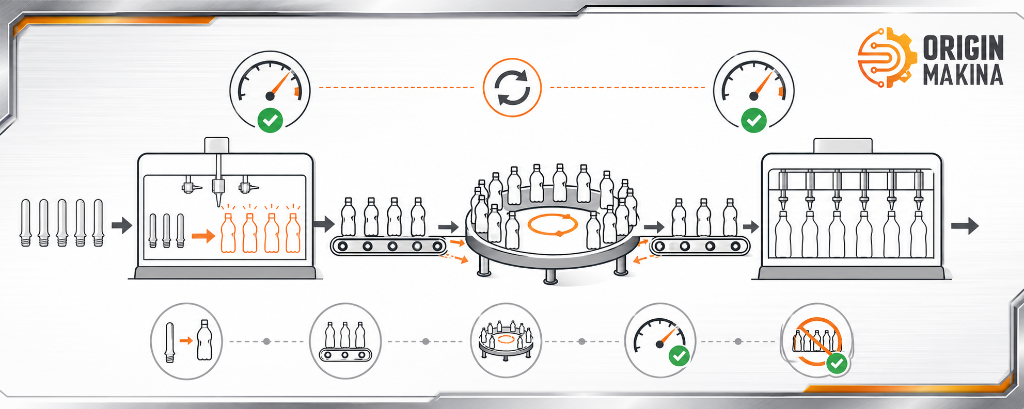
Buffer conveyors and accumulation tables between blower and filler ensure smooth speed-matched operation without bottlenecks.
Bottle design control
When you blow your own bottles, you control the bottle design and can make small modifications without going back to an external mold supplier. This gives you more flexibility to differentiate your product packaging and respond to market requirements faster.
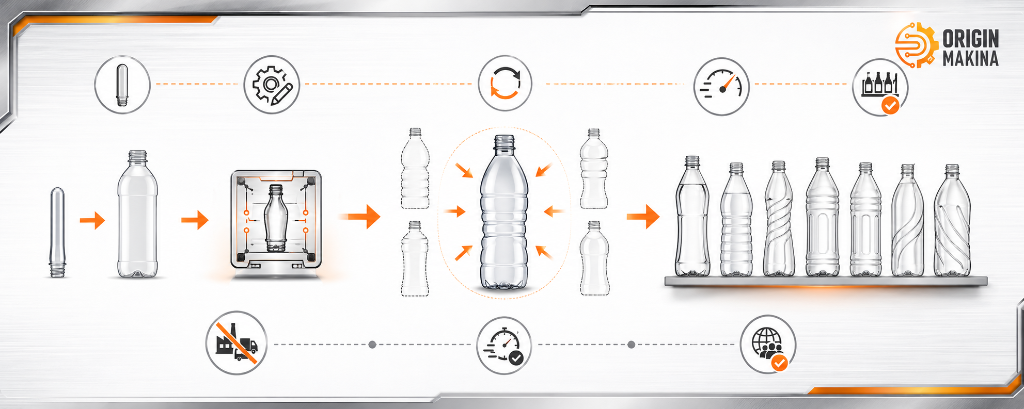
In-house blowing gives full control over bottle shape, wall thickness, and design — faster response to market requirements.
Have a production question?
Interested in whether bottle blowing integration makes sense for your production volume? Our engineers can help you model the numbers.