
How servo piston filling works
A servo piston filler draws product from a holding tank into a cylinder using a piston driven by a servo motor. The servo motor controls the exact piston stroke length, which determines the fill volume. This gives you volumetric accuracy regardless of product viscosity, product level in the tank, or line pressure variations. The fill volume is set digitally and can be changed instantly from the HMI. For multi-nozzle machines, each nozzle has its own servo cylinder, and each can be adjusted independently.
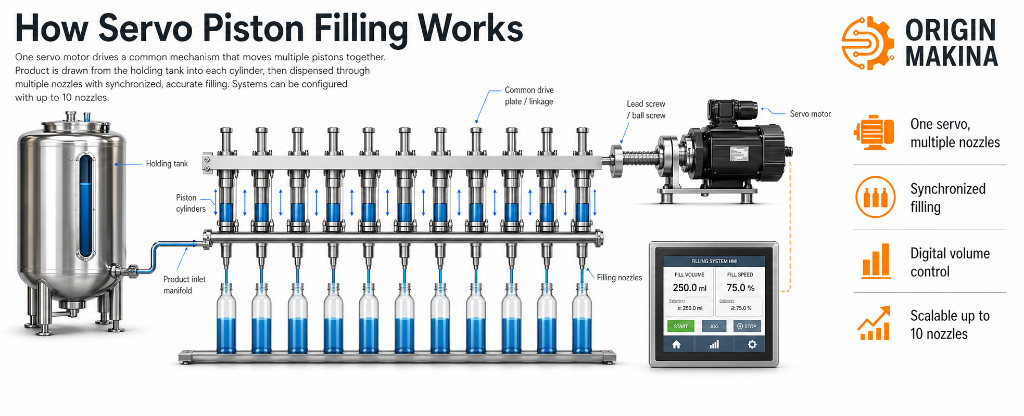
Servo motor drives piston stroke precisely — fill volume is set digitally and each nozzle is independently controlled.
How lobe pump filling works
A lobe pump filler uses positive displacement lobe pumps to move product through the filling nozzles. The pump rotates a set number of times per fill cycle, and the rotation count determines the volume dispensed. Lobe pumps handle thicker, more viscous products very well, and they are excellent for gentle product handling where shear stress must be minimized. They are less affected by product density variation and are well suited for large container filling from 5L to 20L.
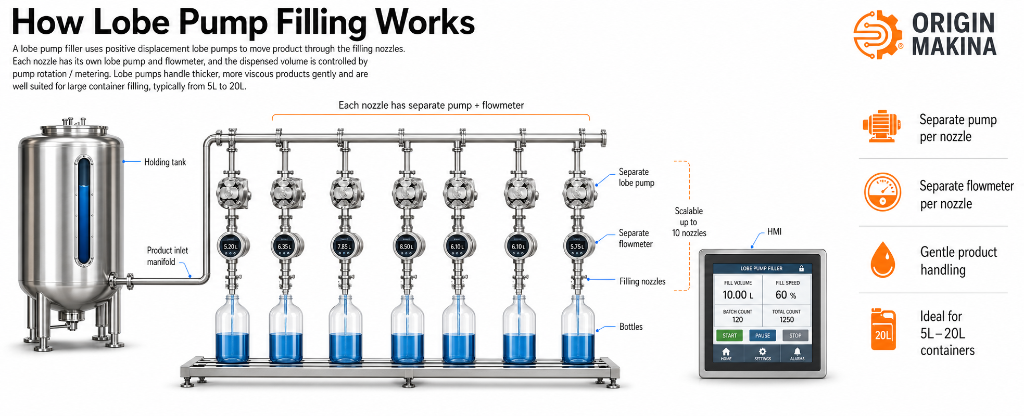
Lobe pump positive displacement — ideal for thick, viscous products and large jerry can formats up to 20L.
Accuracy comparison
Servo piston filling typically achieves accuracy within plus or minus 0.5% of target fill volume for well-running lines. Lobe pump filling achieves similar accuracy for consistent products, but can be slightly more sensitive to temperature-induced viscosity changes in some products. Both systems significantly outperform gravity filling or overflow filling in terms of volumetric precision.
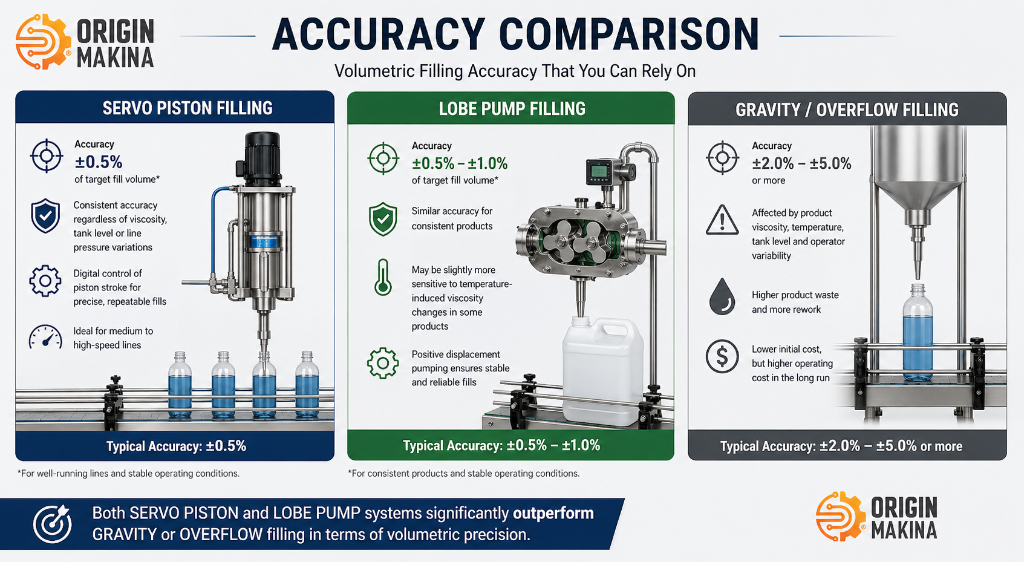
Servo piston systems achieve ±0.5% fill accuracy — critical for compliant volume labeling and reducing giveaway.
Cleaning and product changeover
Both systems support CIP (Clean-in-Place) cleaning for appropriate products. Servo piston fillers tend to be simpler to disassemble for manual cleaning when required. Lobe pump systems have fewer contact points but the pump itself requires careful cleaning. Product changeover speed depends more on your CIP setup and nozzle design than on the filling principle.
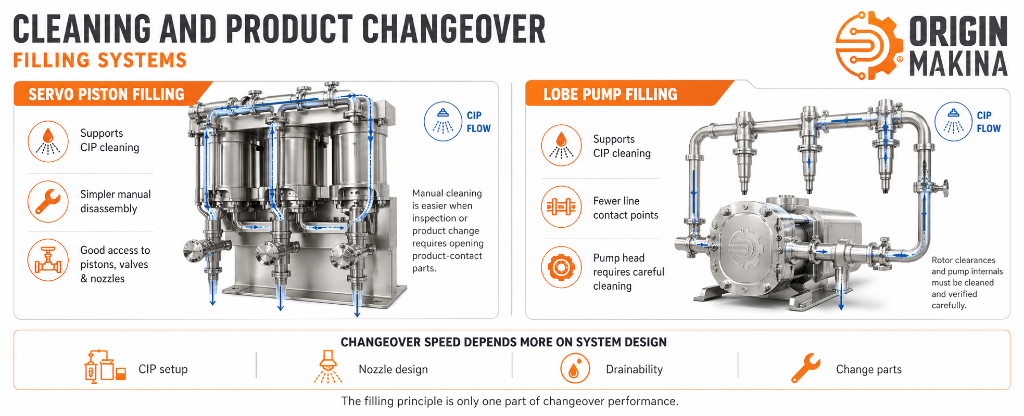
CIP (Clean-in-Place) capability reduces downtime during product changeover — essential for multi-product lines.
Which one is right for you
Use servo piston filling for: products from 0.2L to 5L, products with varying or moderate viscosity, operations where fill volume needs to change frequently, and lines running at medium to high speed. Use lobe pump filling for: large containers from 5L to 20L, very thick or viscous products, products where shear stress must be minimized, and slower-speed high-volume lines. Both systems are manufactured by Origin Makina in 304 and 316 stainless steel.
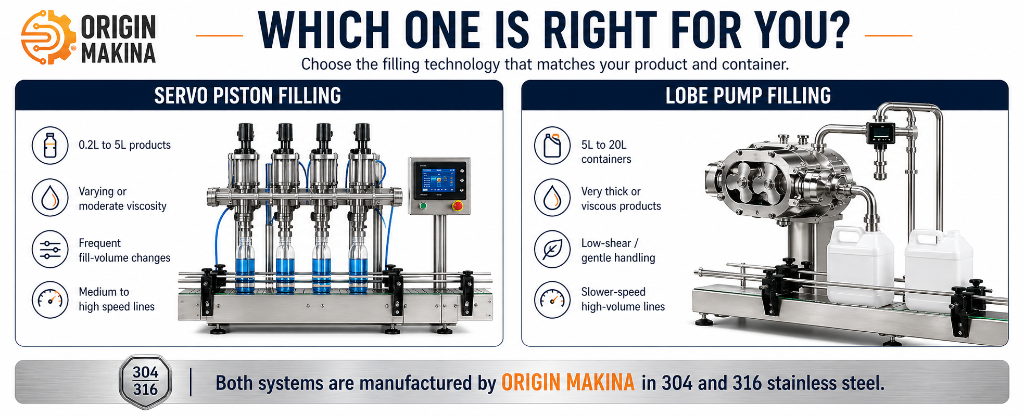
Choosing the right filling system for your product range eliminates costly changeovers and accuracy issues.
Have a production question?
Not sure which filling system is right for your product? Describe your product to our engineering team and we will recommend the right approach.